
A dark patch on a tomato can send you looking for calcium. Before you add any, check whether the shortage is in the soil—or whether calcium is failing to reach the fruit.
Use a soil test and the needs of your crop to decide whether to add calcium. Lime supplies calcium and raises pH. Gypsum supplies calcium without liming the soil. If calcium is already adequate, another bag may not help. LSU AgCenter explains this soil-versus-uptake distinction.
Start with the soil report, then check the way water reaches the roots.
Why plants need calcium
Plants use calcium to build cell walls and support new growth. A shortage can harm developing tissues. But a plant needs more than calcium sitting in the ground: it also needs conditions that let roots take up water and nutrients.
Calcium can help soil particles form stable clumps in some soils. That does not make gypsum a general cure for hard ground or poor drainage. University of Arizona Extension explains why calcium amendments improve soil structure only under particular conditions. If you suspect a sodium-related soil problem, ask the lab or local extension service which tests and treatment apply.
Check the soil before you add calcium
Send a sample to a soil-testing laboratory that serves home gardeners. Follow its sampling instructions and name the crop you grow or plan to plant. Different plants need different soil conditions.
Find these items on the report:
- Soil pH: how acidic or alkaline the soil is.
- Calcium and magnesium results, with the lab's interpretation.
- Whether lime or another amendment is recommended.
- The recommended amount, material, area and retest guidance.
A pH reading alone does not tell you how much calcium to add. A liming recommendation may also use buffer pH, a measure that helps the lab assess the soil's resistance to a pH change. Colorado State Extension explains why soil texture and buffering affect lime needs.
Do not aim for the same pH in every bed. Blueberries and azaleas, for example, prefer more acidic soil than many garden vegetables. Maryland Extension's soil-report guide explains these crop differences and the report's main fields.
Distorted new leaves, slow growth or damaged fruit are reasons to investigate. They do not measure the calcium in your soil. If the report and symptoms do not agree, send clear plant photos and your watering and feeding history to local extension. A tissue test or another diagnosis may be useful.
Choose an amendment from the results
These choices apply to a confirmed soil need. The crop and the lab's recommendation still set the amount.
| Soil-test finding | Possible choice | Effect on pH | Extra nutrient or limit | Next step |
|---|---|---|---|---|
| pH is too low for the crop; lime is recommended | Calcitic agricultural lime | Raises pH | Changes more than calcium supply | Use the lab's liming recommendation |
| pH and magnesium are both too low | Dolomitic agricultural lime | Raises pH | Also supplies magnesium | Confirm the magnesium need with the lab |
| Calcium is needed; pH already suits the crop | Gypsum | Does not act as lime | Also supplies sulfur | Ask for an applicable calcium recommendation |
| Calcium is adequate | No calcium amendment | No change from an added calcium product | Extra calcium may not solve the problem | Check moisture, roots and other causes |
Lime raises pH as well as adding calcium
Calcitic lime contains calcium carbonate. Dolomitic lime contains calcium and magnesium carbonates. Choose between them using the soil report, rather than assuming extra magnesium is always helpful.
Adding lime to soil that does not need it can raise pH too far and make some nutrients harder for plants to use. Use agricultural or garden limestone as recommended. Hydrated lime is a different, more reactive material that can injure plants; it is not an interchangeable shortcut. Maryland Extension describes lime types and their limits.
Gypsum supplies calcium without liming
Gypsum is calcium sulfate. It can supply calcium when a soil test shows a need but raising pH is not the goal. It does not replace lime when the soil needs acidity corrected. NC Agriculture explains this difference.
Do not use gypsum just because soil is clay. Its role in treating sodium-affected soil requires a soil-specific diagnosis and plan. It will not fix every compacted or poorly drained bed.
Calcium nitrate and calcium chloride have limits
These are soluble calcium salts, not forms of garden lime. Calcium nitrate also supplies nitrogen, so using it for calcium can add more nitrogen than the crop needs. Calcium chloride and calcium nitrate also add salts; neither is a general-purpose soil-softening treatment. Follow a crop-specific recommendation and the exact product directions rather than choosing by speed alone.
How to add a recommended amendment
- Measure the planting area. Keep the units used in the report. Ask the lab to clarify any conversion you cannot confidently make.
- Match the material. Check the product's ingredients and directions against the recommendation. Particle size and neutralizing value can matter for lime; two bags may not be equivalent by weight.
- Measure the recommended amount. Account for lime, fertilizer, compost and other amendments already applied. Do not stack several calcium sources to speed things up.
- Use the right placement. Before planting, incorporate lime as recommended. Around established plants, follow advice for surface treatment and protect existing roots instead of digging through them.
- Record the application and recheck as advised. Lime needs time to react. Do not add a second dose because a leaf or fruit has not changed in a few days.
Iowa State's pH guide explains why preplant incorporation, established roots and reaction time need different care. There is no single spoonful-per-plant rate that fits every soil, crop and amendment.
Blossom-end rot: check water and roots
Blossom-end rot causes a dark, sunken patch near the blossom end of fruit such as a tomato or pepper. It involves too little calcium in the developing fruit. That does not, by itself, mean there is too little calcium in the soil.
Calcium reaches the plant with water taken up by roots. Dry spells, large swings in moisture, waterlogged conditions or root damage can disrupt that supply. Excess fertilizer can also interfere. UC Cooperative Extension explains the water and nutrient factors behind blossom-end rot.
Check moisture in the root zone, rather than judging by the dry surface alone. Aim for even moisture suited to the crop, with drainage that lets excess water leave. Mulch can reduce moisture swings. Protect feeder roots when weeding, and avoid extra fertilizer intended to force growth.
If the soil test shows adequate calcium, focus on those growing conditions. If calcium or pH does need correction, address that as well. Watch newly developing fruit to assess the care changes. UNH Extension advises removing affected fruit because it will not recover.
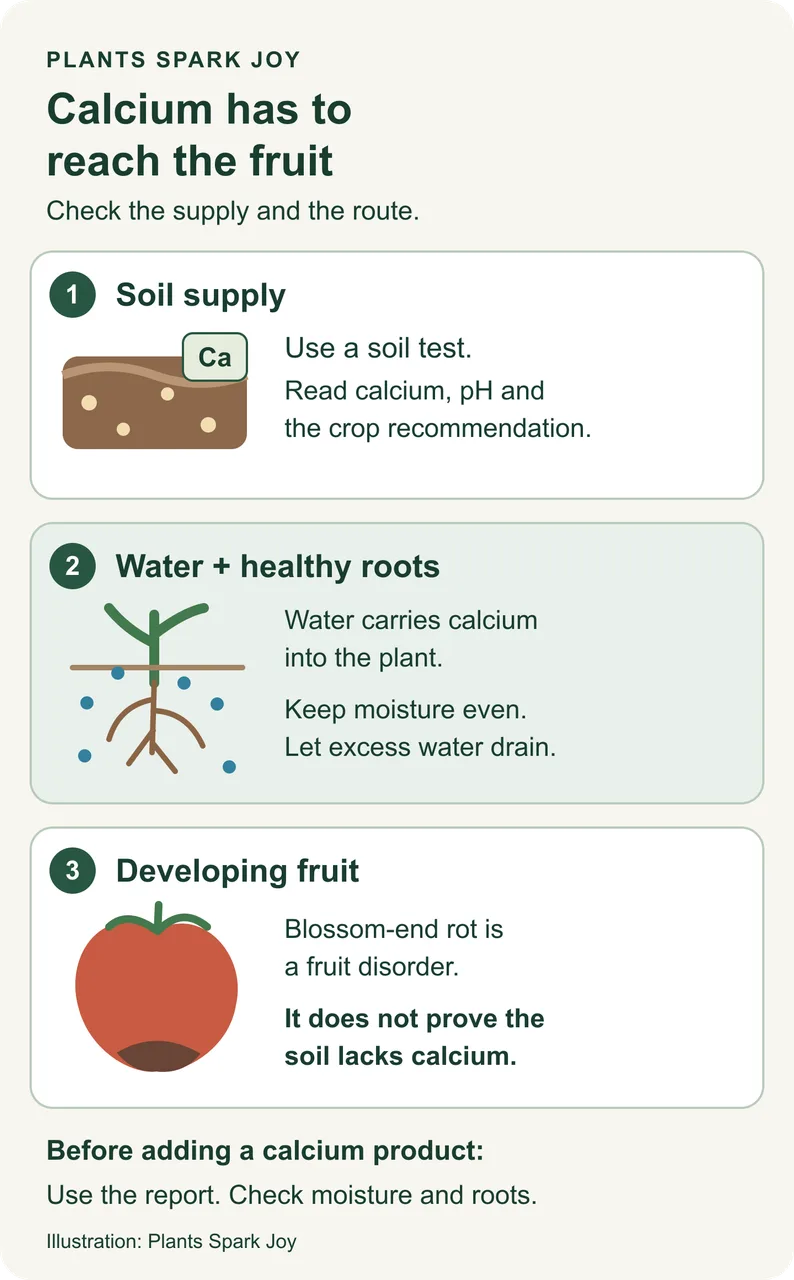
Check the soil supply and water uptake before choosing a calcium amendment. Illustration: Plants Spark Joy.
Can a calcium spray fix the fruit?
Do not count on a leaf spray to carry calcium into fruit. Calcium moves poorly from leaves to fruit, so spraying foliage is not a dependable blossom-end-rot remedy. It also does not correct a dry or damaged root system. Get crop-specific advice before choosing a treatment rather than using a homemade calcium spray.
What about other calcium sources?
“Natural” and “chemical” do not tell you whether a material fits the soil. Its contents, effect on pH, other nutrients and speed of availability matter more.
Eggshells
Eggshells contain calcium carbonate, but crushed shells do not make calcium available quickly enough to treat blossom-end rot. Even a genuine soil shortage needs a suitable amendment plan. N.C. Cooperative Extension explains the gap between shell calcium and timely plant uptake.
Put shells in compost if that suits your composting routine. Do not rely on a handful in the planting hole, eggshell water or a homemade extract as a measured calcium treatment.
Bone meal
Bone meal supplies phosphorus as well as calcium. That makes it a poor automatic choice when the soil needs calcium but already has enough phosphorus. NC State's nutrient guide discusses bone meal and the need to account for all nutrients in an amendment. Check the soil report and product analysis before using it.
Compost and manure
These can contribute nutrients and organic matter, but their nutrient content varies. They are not a measured substitute for a calcium recommendation. Repeated additions also add other nutrients. Use a suitable analysis and soil guidance rather than treating a layer of manure as a calcium dose.
Seaweed extract and mineral supplements
Do not assume seaweed extract, rock dust or greensand provides a useful amount of available calcium for your crop. Check the actual analysis and applicable recommendation. If the calcium content or amount needed is unknown, the product cannot fill a measured calcium requirement. There is no reason to buy it just to cover an unconfirmed shortage.
Prevent another calcium problem
Keep moisture, roots and feeding in the same care plan:
- Check watering more often when weather or plant size changes.
- Keep drainage working; more water is not always the answer.
- Avoid digging close to plants and damaging roots.
- Base fertilizer and amendment choices on the crop, soil results and product directions.
- Retest when the lab advises, rather than adding lime every year by habit.
University of Minnesota Extension recommends steady moisture, root protection and test-based feeding. Extra supplements cannot replace those checks.
Common questions
What is the fastest way to add calcium to soil?
A soluble source can release calcium more readily than limestone or shells. But speed does not establish need or suitability. First identify whether the problem is soil supply, pH or uptake. A fast calcium addition will not repair blossom-end rot caused by disrupted water movement.
What is the best source of calcium for plants?
Use the soil result: lime when liming is needed; an appropriate non-liming source such as gypsum when calcium is needed but pH should stay where it is. No calcium amendment may be the right choice. Check magnesium and other nutrients before selecting the exact material.
Should I add calcium to a container?
Check the potting-mix ingredients and fertilizer history first. Ask the testing lab which test is suitable for your growing medium before applying a garden-soil recommendation to a pot.
For a container tomato with blossom-end rot, check wetting and drainage, too. Our guides to water running through potting soil and choosing a pot with suitable drainage and fit can help with those checks.
Does Epsom salt add calcium to soil?
No. Epsom salt is magnesium sulfate. It supplies magnesium and sulfur, not calcium. Adding unnecessary magnesium can interfere with calcium uptake. It is not a blossom-end-rot prevention step.
Keep the soil-test recommendation with your garden notes
Save the report, the crop name and a photo of the amendment label. Note the measured area, product, amount, date and application method. Add the lab's retest guidance and a few observations about moisture and new growth.
Use that record before the next application. It will help you avoid adding more calcium when the useful next step is a watering change, a root check or no amendment at all.


