
A humidifier can help a humidity-loving plant in a dry room. Before you buy one, check the air as well as the plant. Brown leaf tips alone do not tell you what is wrong, and a bigger tank is not always the most useful choice.
Start with a humidity reading, then think about cleaning, refills and where the unit will sit. This guide uses published plant-care advice and product instructions. We have not tested or ranked humidifiers.
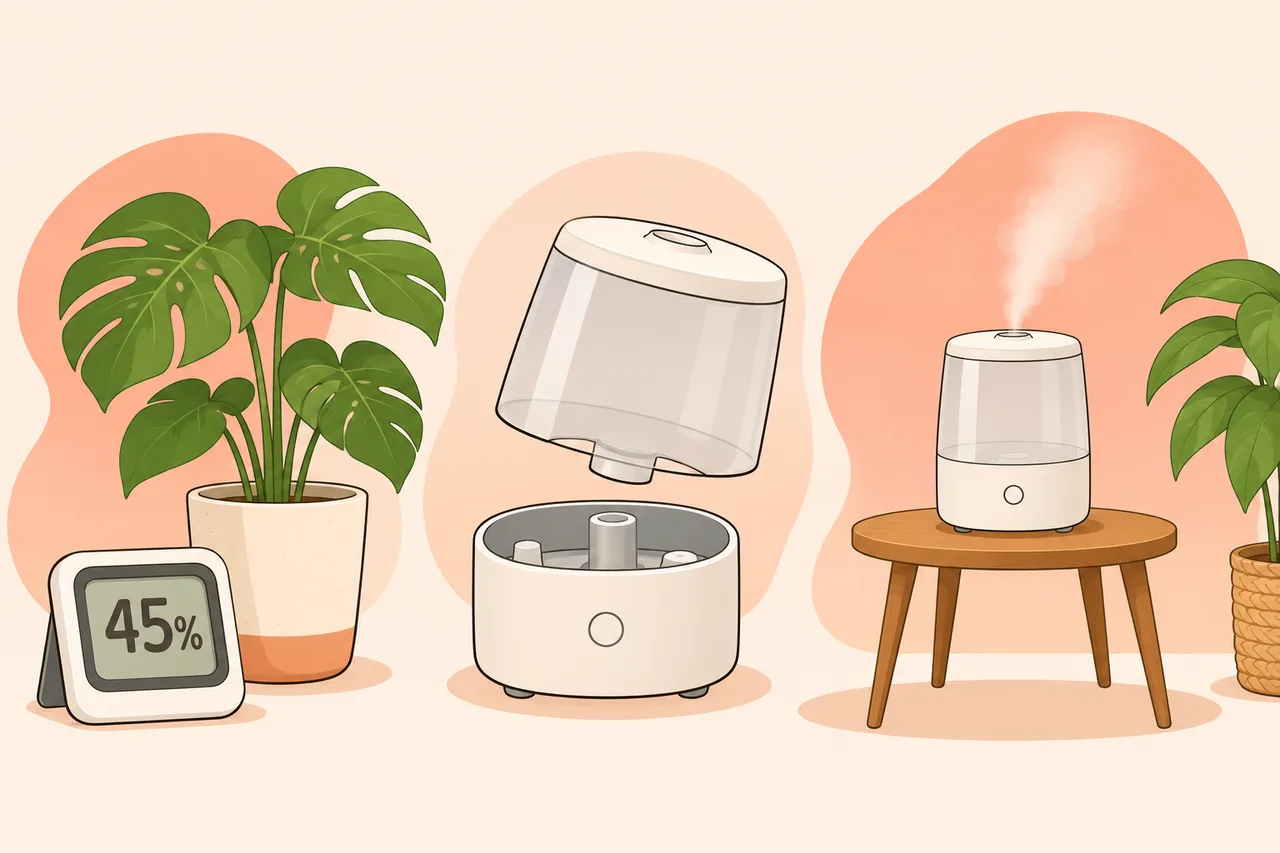
Illustration: check room humidity, cleaning access and placement before choosing a humidifier.
Check whether your plants need extra humidity
Humidity is moisture in the air. A hygrometer measures relative humidity, or RH, as a percentage. It gives you a better starting point than guessing from a crisp leaf edge.
First, check the plant's needs. Cacti and many other succulents tolerate drier air than humidity-loving houseplants. University of New Hampshire Extension explains these differences and recommends monitoring humidity near the plants.
Brown tips and wilting can have several causes. Too much or too little water, damaged roots, excess fertilizer salts, heat and low humidity can cause similar signs. Check the potting mix and growing conditions before choosing a fix. UC IPM's houseplant guide can help you sort through them. Our watering guide covers the separate job of checking when the roots need water.
For the room itself, the US Consumer Product Safety Commission suggests keeping home RH between 30% and 50%, if possible. The EPA advises against humidifying a room above 50% RH. A tropical plant's preference for more moisture is not a reason to make the whole room damp. A suitable enclosure may be a better option for a small plant that needs a very humid setting.
As a useful first check, note the RH near the plants and elsewhere in the room, along with the time and whether the heating is on. Compare readings under your usual conditions. If the air already suits your plants and the room, a humidifier may add work without solving a problem.
Try a smaller change first
Move plants away from drying heat vents, while keeping the light they need. Grouping plants may raise humidity in their small shared area. A pebble tray can offer a modest local benefit, too; keep the pot above the water. Neither method promises to humidify a whole room. UNH Extension explains where these approaches help and where they fall short.
Misting leaves is not a dependable substitute for steady humidity. University of Maryland Extension questions how much it helps. A shower or leaf rinse is also a different task from controlling room RH.
For a small plant that suits an enclosure, a terrarium or cloche may be an option. Choose plants suited to that setting and check for excess moisture; some enclosures need ventilation. Do not assume every houseplant belongs under glass.
Compare humidifier types
The main difference is how each unit adds water to the air:
- Evaporative: a fan moves air through a damp wick or filter. The moisture output is invisible. Check the wick's care and replacement needs.
- Ultrasonic: a vibrating part makes fine droplets. Minerals in the water can travel with that mist, leaving white dust.
- Warm mist or steam: the unit heats water. Hot water and steam need care around children.
The EPA's humidifier guide explains these mechanisms and the risks of dirty tank water. Every type needs upkeep. “Filter-free” does not mean cleaning-free.
For water choice, follow the exact unit's instructions. CPSC recommends distilled or demineralized water to reduce scale and dust. Include that water supply in your plans, especially when considering an ultrasonic unit.
Choose by everyday use
Use these checks to compare a few suitable models. The best fit is a unit you can place, refill and clean comfortably.
| Check | What to find out | Choose or skip |
|---|---|---|
| Room RH and controls | Does it control a chosen RH level, or only offer output speeds? What does “auto shutoff” mean? | Choose controls you understand. Keep a separate humidity reading; an empty-tank shutoff does not set room RH. |
| Cleaning access | Can you reach the tank and wet parts with the tools the manual calls for? | Skip a design you cannot clean as directed. A wide opening alone does not show that every wet part is reachable. |
| Refills and handling | Will the tank fit your tap or filling spot? Can you carry and replace it when filled? | Choose a manageable fill amount. A larger tank can mean fewer refills but more water to carry. |
| Wick and other supplies | What exact replacement part is needed, how often, and what will it cost you? | Include replacement wicks, cartridges and water in the upkeep budget. |
| Room and placement | Will it fit on the required surface with the clearances in its manual? Is the room open to other spaces? | Use the maker's room claim as a starting point, then monitor the actual result. Skip a unit you cannot place properly. |
| Noise and lights | Can you adjust the fan or mist setting and switch off unwanted lights? | Choose for the room where you will use it. Look for a chance to hear it; “quiet” is not a measured comparison here. |
Read the control details closely. For example, the MistAire PEHUMIDIF manual describes two mist levels and a low-water shutoff. Those features serve different jobs from a control that holds a chosen room RH.
Wick upkeep also varies. Honeywell's care guidance for its filtered cool-moisture units gives a 30–60-day replacement interval, depending on water and use. That is an example of an ongoing cost, not a schedule for every brand or model.
Before you choose a named model
Match the full model number to its current manual. Check the tank, filling method, humidity controls and replacement parts. Similar names can cover different versions, so a photo or a brand name is not enough.
Read the runtime claim with its setting. A maximum runtime does not tell you how well the unit will hold your chosen RH in your room. For example, the PEHUMIDIF manual gives different runtimes for low and high output. The same tank can empty at different rates.
We are not naming a winning model here. Use the checks above to make a short list, then rule out anything that fails your cleaning, filling or placement needs. Keeping an existing unit that works and can be maintained may be the right choice.
Set up and care for your humidifier
Follow the model's placement instructions. Use the required stable surface and clearances, keep water away from electrical equipment, and do not aim a mist stream at furniture or other objects. The PEHUMIDIF manual gives one model's instructions; check your own manual before copying its setup.
Start with a modest output and watch the humidity reading. Reduce use if the room becomes damp or water collects nearby. Adjusting a humidifier is not a reason to leave a plant's potting mix wet.
Build these jobs into your routine:
- Change the water. Unplug the unit first. Each day, empty the portable unit's tank, wipe the wet surfaces dry and refill with fresh water, following its manual.
- Clean the wet parts. The EPA recommends cleaning portable humidifiers every third day. Use the model's cleaning method and keep up with its other care needs.
- Follow the cleaning steps. Keep the unit unplugged while cleaning. Follow the instructions for rinsing out cleaners and caring for filters. Do not use a tank-cleaning mixture on a wick unless the maker directs it.
- Dry before storage. Drain, clean and dry the unit when putting it away.
CPSC's humidifier precautions explain why clean water, careful cleaning and proper storage matter. A humidifier bought for plants still affects the people sharing the room.
Questions before you buy
Are humidifiers good for every plant?
They can help when the plant needs more humidity and the room is dry. They are not needed for every plant or every room. Check the species, measure the air and consider other causes of leaf damage first.
Which kind should I choose?
Choose by the room, water supply, controls and care you can keep up with. Compare wick replacement for an evaporative unit with the water and cleaning needs of an ultrasonic one. A visible cloud of mist is not a measure of how well either type meets your needs.
Can I run it at night?
There is no blanket rule that plant humidifiers must be off at night. The Honeywell HCM350 manual, for example, describes a low fan setting for nighttime use. Follow your unit's instructions and keep RH and nearby surfaces in check. Room humidification is different from misting leaves or watering a pot.
Can a diffuser do the same job?
Do not assume an aroma diffuser can control room humidity. Check its intended use and instructions. A mist alone does not show that it can maintain a useful RH level.
Use only additives your humidifier's maker permits. The PEHUMIDIF manual prohibits essential oils and other water additives. Oil-diffusing features are not needed to solve a plant's humidity problem.
Take your room readings and the comparison checks with you when you shop. Choose a humidifier only when it solves a measured need and its everyday care fits your home.