A grow-light bulb can work in some table and floor lamps. But two things need to line up: the bulb must be allowed in that lamp, and useful light must reach the plants you want to help.
A lamp beside a plant may pass one check and fail the other. The bulb might fit, while its light points at the ceiling. Or the leaves may sit in its path, while the lamp's dimmer is wrong for the bulb.
Before you buy, grab a sheet of paper and look at the setup from above and from the side. You can often spot a poor match without spending a thing.
Give this light one job
Pick the plant or small group you want to help first. Write down its names and what you want the light to do. “Help these two houseplants through a darker season” is a clearer job than “light this whole corner.”
Check each plant's light needs with a reliable care source. Plants grown for leaves, flower buds, ripe fruit, and seedlings do not all need the same setup. University of Minnesota Extension explains why the plant and its light must match.
For this check, start with plants grown for their leaves that have similar light needs. Keep a seed tray or a plant you want to bring into bloom on its own plan. A good place for one pot does not settle the question for the next.
Make a quick note of daylight, too. Where is the nearest window? Do curtains, a porch roof, or a building block it? Look at the leaves' position rather than the view from the sofa. Maryland Extension notes that the light leaves receive depends on distance and obstructions.
You do not need to assign your room a perfect light score. Start with a plain description: “Window light from the left; tall shelf blocks the right; lamp would help the front of the group.”
Check the lamp and bulb as a pair
Find the lamp's label and instructions. Then find the instructions for the exact bulb you are considering. Use the model sold in your country. A similar name or photo is not enough to identify it.
Write the details down before you compare them. If the lamp's label is missing or the directions are unclear, ask its maker. Leave that combination on hold until you have an answer. GE Lighting's general FAQ also points readers to the fixture maker's wattage, voltage, and bulb-shape rules.
Here is what to check:
| Check | What to look for in both sets of instructions |
|---|---|
| Base and supply | The required socket/base and the rated voltage for your region. A base that seems to fit does not settle the whole check. |
| Bulb type and input power | The bulb types allowed by the lamp, the bulb's actual input watts, and the lamp's limits for that type. Follow any separate LED limit. |
| Size and space | Bulb length, width, and weight if limited; required space around it; and whether it fits without touching the shade or other parts. |
| Heat and enclosure | Whether this bulb is allowed in this kind of shade or enclosure, with the required air space and ventilation. |
| Direction | Whether the bulb may face the way this lamp holds it. Check any limits on position. |
| Controls | Whether the bulb works with this lamp's switch, dimmer, touch control, or three-way socket, and any timer you plan to use. |
Treat a missing answer as a question, not a yes. Do not assume an open shade meets an enclosed-fixture rule, or that turning a dimmer all the way up makes it suitable.
The Department of Energy's bulb guide calls out fit, enclosure suitability, and dimmer compatibility as checks when choosing LEDs. It does not approve your particular grow bulb and lamp.
Actual watts and “equivalent” watts mean different things
Actual input watts tell you how much power the bulb uses. An incandescent-equivalent number compares visible brightness with an older bulb. It is not the bulb's power draw, and it does not tell you how much plant light reaches a leaf. The Department of Energy distinguishes power input from equivalent light output.
Copy the actual input rating into your notes. Compare it with the lamp's stated limits and allowed bulb type. Do not use the equivalent number as the input rating. And do not treat a low input number as proof that every other check passes.
If the instructions conflict, stop that pairing. You can choose another documented setup. There is no need to change wiring, defeat a control, add a socket extender, or improvise a mount to make this project work.
Draw where the light would go
Now look at the room layout. Keep the lamp unplugged while checking labels or moving it, and follow its instructions before changing a bulb or adjusting parts.
Draw two small views on your paper:
- Top view: look down on the lamp, plant group, wall, and nearby shelf.
- Side view: show the bulb's face, the shade, and leaves at different heights.
Mark three leaf positions with A, B, and C. Choose a leaf near the middle of the group, one at the outer edge, and one at a different height or behind another plant. For a large plant, these can be three spots on the same plant. They are sample checks, so look for other shaded spots too.
Draw an arrow from the part of the bulb that gives off light in the direction it sends light. Check the bulb's diagram; do not guess from its screw base. Then draw a path toward each marked leaf. Put an X where a shade, shelf, or another plant gets in the way.
This sketch asks, “Is there a clear path worth checking?” It cannot tell you whether enough light arrives. Reflected light may also reach a leaf, but the sketch does not measure that either.
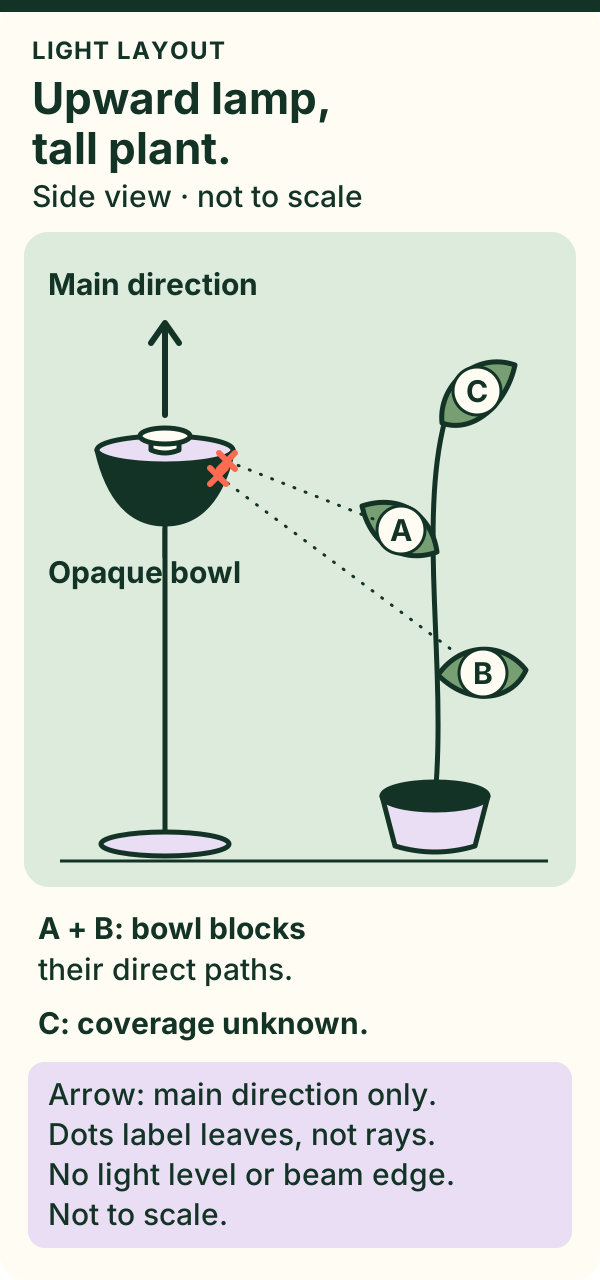
Original layout sketch: an upward-facing lamp beside a tall plant. X marks the bowl that blocks direct paths to A and B. Dots connect that label to the leaves; they are not light rays. The arrow shows the main direction, not measured light or a beam boundary. Not to scale.
TOP VIEW — looking down

   [lamp bowl]          [tall plant]
   light points        A: middle leaves
   up, out of          B: outer/lower leaves
   this view           C: high leaves

SIDE VIEW — the height check adds the missing detail

          ↑ main direction                  (C) high leaf
       [bulb face]                          coverage unknown
     [opaque bowl X] . . . . . . . . . . . (A) middle leaves
                  . . . . . . . . . . . . (B) edge/lower leaves
           |       X = the bowl blocks direct paths to A and B
           |
        lamp base                          plant pot
      ------------------------------------ floor
Your sketch may look quite different. If the lamp aims down, draw the arrow down. If the shade sits between the bulb and the plant, draw it there. A tidy drawing is less useful than an honest one.
Read diagram as text
- The lamp points up. Its opaque bowl blocks direct paths to the middle and lower leaves marked A and B.
- Leaf C is above the rim and off to one side. Its coverage is unknown.
- The arrow shows main direction only. Dots connect the bowl's X marks to A and B; they are labels, not light rays. This drawing shows no measured light level or beam edge and does not approve a bulb and lamp pairing.
Check coverage at the leaves
Look for the bulb maker's coverage diagram or plant-light guidance. Match the exact bulb model, its direction, and the stated distance. Check where that distance is measured from; use the maker's reference point rather than assuming it starts at the socket.
Write the distance to each marked leaf, using the same units as the instructions. Keep the center and edge separate. A number given at the center does not tell you what reaches the edge.
You may see PPFD on a grow-light chart. It describes how much light in the range plants use to make food reaches a given area each second. For this task, the useful question is what reaches the leaf positions you marked. Iowa State Extension explains PPFD, distance, angle, and leaf-level checks.
A clear path alone does not pass the light check. Nor do the bulb's watts or a bright patch on the wall. If you only have a broad claim such as “covers several plants,” ask for the model's coverage guidance at your planned distance. If the chart gives numbers but your care guide only says “bright, indirect light,” you may not be able to compare them. Keep coverage marked unknown and ask the maker or a plant-care adviser for help before counting on this light.
A suitable meter can help if you already have one and know how to use it. Check it at leaf level and follow its settings for the light source. A phone reading is not enough on its own to approve this setup. You do not need to buy a meter to complete the paper check; “coverage still unknown” is a useful result.
Two room layouts, two different choices
These are made-up layouts to show how to use the sheet. They are not product tests or approved lamp-and-bulb pairs.
The tall plant beside an upward-facing lamp
Picture a floor lamp with a bowl-shaped shade. The planned bulb sends its main light upward. A tall plant stands beside it, with most leaves below the bowl's rim.
On the side sketch, the light arrow goes toward the ceiling. The path to leaf A hits the opaque bowl. Leaf B, farther down, has the same problem. Leaf C sits above the rim, but off to one side. There is no coverage information for that spot.
Write “blocked” for A and B, and “unknown” for C. Do not mark the whole plant as covered just because its top leaf is near the lamp.
The next step could be moving the plant to a place with better documented light, or checking a different fixture that aims where needed. If the lamp is meant to face upward, leave it that way. Do not tip the whole lamp or alter the shade to chase a light path.
You may decide to keep that lamp for room light and buy no grow bulb for it. That is a complete answer.
The smaller group under an adjustable lamp
Now picture an existing adjustable lamp that can point down within its normal range. Suppose the exact lamp and bulb instructions allow the planned combination and position.
Two small houseplants sit on a shelf. Their care guidance calls for similar light. A third, taller plant stands behind them.
The coverage guide gives you information at the planned distance. In your sketch, A sits near the middle, B sits at the edge, and the tall plant blocks the path to C.
Try drawing just the two smaller pots under the light. Can you match both A and B to the documented coverage and their care needs? Can you still lift each pot out to water it? Will the setup stay clear of the sofa and walking space?
If those checks work, the smaller group is a candidate for this lamp. The tall plant still needs its own plan. Adding every nearby pot back into the group would bring back the problem you just solved.
Make a day-and-night plan
Set the daily routine from guidance for the plants you chose. Include their daylight exposure when planning the lamp's on and off times. Do not treat the lamp hours as an extra full day after the sun goes down.
Plants' responses to light and dark periods differ, especially when flowering is the goal. Maryland Extension explains why plants need a dark period and why the full daily light schedule matters.
Write down an on time, an off time, and the care source you used. If you add a timer, check that it suits the lamp and bulb. Do not leave the light on all night to avoid answering a coverage question.
Also ask whether the plan fits your room. A lamp you need to switch off during its planned hours will not follow the plan on paper. Moving the small group may be more practical than changing how everyone uses the living room.
Print your lamp-and-leaf check
Copy or print this sheet. Use another page for the top and side sketches. If you do not have a bulb yet, fill in its details from the exact model's instructions. Keep any unanswered item marked unknown.
MY LAMP-AND-LEAF CHECK                        Date: ___________

ONE JOB FOR THIS LIGHT
Plants / goal: ______________________________________________
Care source for their light needs: ___________________________
Window light and things that block it: _______________________

EXACT EQUIPMENT
Lamp maker / model / region: _________________________________
Lamp label photo or instructions saved at: ___________________
Bulb maker / model / regional version: ________________________
Bulb instructions saved at: __________________________________

PAIR CHECK — write confirmed, conflict, or unknown
Base and supply voltage: ____________________________________
Allowed bulb type / actual input watts / lamp limit: __________
Bulb size and any weight limit: ______________________________
Required space / ventilation / enclosure: ____________________
Allowed bulb direction: ______________________________________
Switch / dimmer / touch / three-way / timer rules: ____________
Missing answer to ask the maker: _____________________________

DRAW THE TOP AND SIDE VIEWS ON THE BACK
Mark bulb face, direction, shade, window, shelves, and pots.
Mark A = middle, B = edge, C = higher, lower, or behind others.
Use the maker's distance reference point and units.

LEAF A  Plant / spot: ________________________________________
Distance: __________ Path: clear / blocked / unknown
Coverage / plant needs match? confirmed / no / unknown
Guide or missing answer: ____________________________________

LEAF B  Plant / spot: ________________________________________
Distance: __________ Path: clear / blocked / unknown
Coverage / plant needs match? confirmed / no / unknown
Guide or missing answer: ____________________________________

LEAF C  Plant / spot: ________________________________________
Distance: __________ Path: clear / blocked / unknown
Coverage / plant needs match? confirmed / no / unknown
Guide or missing answer: ____________________________________

Could other leaves be shaded or outside that coverage? _______
Can I reach and remove pots for watering? _____________________
Can the setup stand safely clear of people and spilled water? __

DAILY ROUTINE FROM THE PLANTS' CARE GUIDANCE
Daylight exposure: __________ Lamp on: ______ Off: ___________
Dark period planned: ________ Source: ________________________

MY NEXT STEP — choose one
[ ] Use this documented setup for the checked plant(s).
[ ] Reposition or use a smaller group, then check it again.
[ ] Get missing instructions or coverage information first.
[ ] Use another light or location. No purchase needed today.

What I will change or ask: ___________________________________
Recheck date: __________ Also recheck after moving the setup.

This sheet is a layout and instructions check. It does not
measure light, certify a lamp, or promise plant growth.
Choose what happens next
Use the sheet to make one small, clear decision:
| What you found | Next step |
|---|---|
| The exact equipment checks pass, and coverage matches the selected plants' needs at their leaf positions. | Use that documented setup for those plants, following its instructions and their care guidance. |
| Some leaves are blocked or outside the documented coverage. | Try another position or fewer pots. Repeat the leaf check before relying on the new layout. |
| A label, control rule, or coverage detail is missing. | Hold that pairing and ask for the missing information. |
| The lamp cannot aim at the leaves within its instructions, or the equipment rules conflict. | Choose a different light or plant location. Keep the existing lamp for its usual job. |
Save a photo of the layout beside your sheet. As the plants grow or you move a pot, check the leaf positions again. A new leaf may be closer to the bulb, while a taller plant may shade its neighbor.
The useful result is a plan for the leaves you have, in the room you use. That might call for one compatible bulb. It might also be two pots on a different shelf and nothing added to your cart.