
Yellow leaves or a dark patch on a tomato can make a cheap bag of Epsom salt look like an easy fix. Before you add it, find out what the plant needs.
Epsom salt supplies magnesium and sulfur. It can help correct a confirmed shortage, but it is not a complete fertilizer or a routine cure for plant problems. If the plant already has enough magnesium, adding more may create another problem. University of Maryland Extension recommends applying it to garden soil only when a soil test report calls for it.
Start with the plant, its growing conditions and the right kind of test. A spoonful added “just in case” skips those useful checks.
What Epsom salt supplies
Epsom salt is magnesium sulfate, a soluble mineral salt. Magnesium and sulfur are essential plant nutrients. They are classed as macronutrients, rather than trace nutrients. Magnesium is part of chlorophyll, the pigment that helps leaves capture light.
That role does not mean more magnesium will make every leaf greener. A plant needs enough of each nutrient, and healthy roots and suitable conditions to use them.
Plain magnesium sulfate does not supply nitrogen, phosphorus, potassium or calcium. It cannot replace a feeding plan that supplies the other nutrients your plant needs. Chicago Botanic Garden makes this distinction in its answer about fertilizing roses.
Check the problem before adding anything
Look at the whole plant before deciding that a leaf-color change is a magnesium shortage. Check light, soil moisture, drainage, recent weather and recent feeding. Note whether the oldest leaves or the newest growth changed first.
Magnesium shortage can cause yellowing between leaf veins, often starting on older leaves. But a photo or that pattern alone is not a diagnosis. Other nutrient problems and growing conditions can look similar. An excess of potassium can also interfere with magnesium uptake even when magnesium is present.
The RHS nutrient-deficiency guide explains these overlapping signs and growing conditions. Its treatment rates are for particular UK contexts; use local advice for your own plant and growing medium.
For garden soil
Ask a soil-testing lab which test covers magnesium and the crop you grow. Follow its sampling instructions and tell it about fertilizers, compost, manure and supplements already used. Send the plant name and a description of the problem so the results have useful context.
A pH reading alone does not measure magnesium. “Acidic soil” is not enough information to choose Epsom salt, lime or another amendment. Ask for help interpreting the report if it shows a shortage or imbalance.
For pots and houseplants
Check the potting-mix bag and fertilizer label first. The mix or current feed may already contain magnesium. A newly bought plant may also have fertilizer in its pot, even if you have not added any yourself.
Tell the lab if the plant grows in a soilless potting mix rather than garden soil. These materials need different test methods and interpretation. UMass Extension explains why field-soil and container-media results are not interchangeable. Ask what sample and test are appropriate before mailing material.
If your concern began with a change in water, review the actual supply and the plant’s care. Our distilled-water guide can help you make that choice. A different water source is not, by itself, a reason to add Epsom salt.
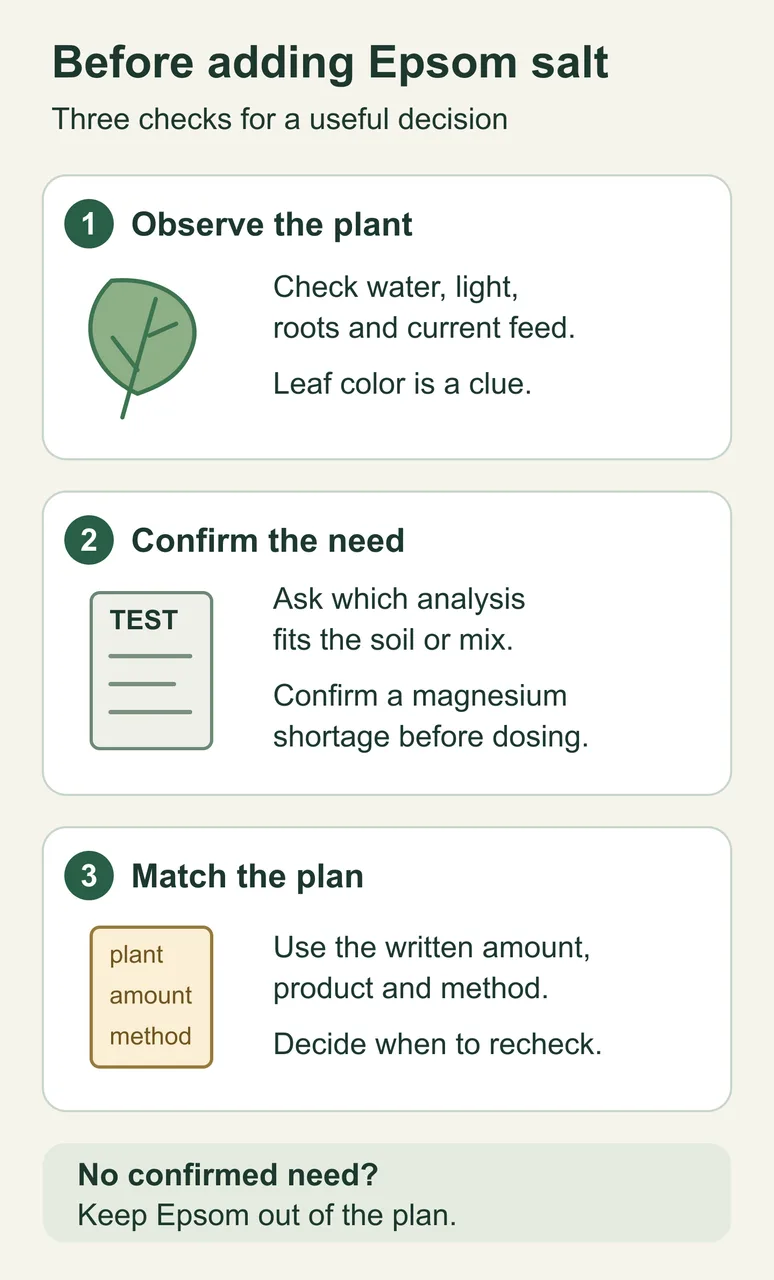
Check growing conditions and confirm the need before choosing a magnesium treatment. Illustration: Plants Spark Joy.
Choose the next step
Use the observation to decide what to check, rather than jumping straight to a treatment.
| Observation | Check first | Why Epsom is not automatic | Useful next step |
|---|---|---|---|
| Plant is growing well | Current mix and feeding plan | Extra magnesium may be unnecessary | Keep the existing care routine |
| Older leaves yellow between veins | Water, roots, feeding history and suitable analysis | Several problems can look alike | Confirm the cause before adding nutrients |
| Dark, sunken patch at the fruit’s blossom end | Whether it is blossom-end rot and how water reaches the roots | Epsom salt supplies no calcium | Review moisture, roots and crop guidance |
| Analysis confirms magnesium shortage | Crop, medium, current feed and written recommendation | The right amount and method still vary | Follow an applicable correction plan |
If magnesium deficiency is confirmed
A useful recommendation identifies both the problem and how to correct it. Before applying anything, make sure the plan covers:
- The plant or crop and whether it grows in the ground or a container.
- The actual product and its nutrient concentration.
- The measured amount and the area or potting-mix volume it treats.
- Whether it is a soil application or a leaf treatment.
- When to reassess, and whether another application is needed.
Match the product directions to that recommendation. If the lab gives a magnesium amount but your package gives a product amount, ask for help with the conversion. Do not transfer a garden-bed rate into a small pot by guesswork.
Also review other feeds before combining them. A fertilizer may already supply magnesium, and a nutrient imbalance may need a change to the existing plan. Our slow-release fertilizer guide explains how to check nutrients already being supplied over time.
How much Epsom salt per gallon of water?
There is no single mixture that is right for every plant, deficiency and application method. A concentration in a watering can also leaves an important question unanswered: how much solution reaches each pot or area?
Use the amount, application volume and method in the applicable written plan. If those details are missing, resolve them before mixing. A plant showing no immediate damage is not a reason to increase the dose.
Should you spray it on leaves?
Leaf treatments can have a place in a specific magnesium-deficiency program. That does not make a homemade Epsom spray useful for routine leaf care.
Sprays can scorch leaves. Do not turn a soil-application instruction into a foliar recipe, or use a regular spray calendar to chase greener foliage. Washington State University’s horticultural review separates deficiency treatment from broad garden promises.
Tomatoes, peppers and blossom-end rot
Epsom salt does not prevent or reverse blossom-end rot. It supplies no calcium. This disorder involves too little calcium reaching developing fruit; it does not always mean the soil lacks calcium.
Uneven moisture and damaged roots can limit calcium movement. Start by checking watering, drainage and root disturbance. Keep moisture suitable for the crop, rather than alternating between very dry and waterlogged soil. Avoid deep cultivation close to the plant’s roots.
Kansas State Extension explains the water-and-root connection. Mississippi State Extension also rejects Epsom salt as a blossom-end-rot remedy.
Too much magnesium can interfere with calcium uptake and make the problem worse. A tomato or pepper with a separate, confirmed magnesium shortage may need a magnesium correction. That is a different decision from treating damaged fruit.
Roses, houseplants and more blooms
A plant’s name does not tell you that it needs Epsom salt. Roses, tomatoes, peppers and houseplants all need magnesium, but they do not all need extra magnesium.
For roses with weak growth or few flowers, check light, water, pruning and the overall nutrient plan. For houseplants, check the mix, existing fertilizer and growing conditions. More flowers or greener leaves cannot be promised by adding one mineral.
Correcting a real nutrient shortage can improve plant growth. That benefit does not establish an automatic monthly Epsom treatment for a healthy plant. University of Minnesota Extension limits the case for added Epsom salt to a demonstrated magnesium need.
Seeds and pest remedies
Skip routine Epsom seed soaks
Do not add an Epsom soak to a seed-starting routine just to speed germination. The WSU review did not establish that broad claim. Follow the seed’s own sowing instructions, including any specified treatment, and provide suitable moisture and temperature.
Identify pests before choosing a treatment
Epsom salt is not a supported substitute for identifying and managing snails, insects or other pests. The same review found the familiar pest-control promises unsupported.
Inspect the plant and the damage, identify the pest, and choose guidance for that pest and crop. Sprinkling magnesium sulfate around a plant adds nutrients; it does not establish a useful pest barrier.
Will Epsom salt correct soil pH?
Do not use Epsom salt to “neutralize” garden soil. Magnesium sulfate is not interchangeable with lime or elemental sulfur. Choose any pH amendment from a soil test and the needs of the crop.
It also does not add the organic matter that compost supplies. Improving soil structure and correcting a mineral shortage are separate jobs. A bag that dissolves easily cannot replace all the functions of a soil amendment.
Solubility does not make overuse harmless. Excess nutrients can leave the root zone with water, and excess magnesium can disturb nutrient uptake. Avoid adding more when the reason for the original application is still unclear.
If you have already added Epsom salt
Pause further Epsom applications while you work out what was used. Keep the package and write down the amount, dilution, date and area or pots treated. Include any other fertilizer used at the same time.
If the plant develops scorch, wilt or other trouble, seek advice for the plant and medium with that history in hand. Do not add another amendment to “balance it out,” or repeatedly drench a poorly drained pot by guesswork. Those actions can complicate the original problem.
Keep a short decision record
A few notes will help you decide whether a treatment is needed:
- Plant name and growing medium.
- Symptoms, where they began and photos showing the change.
- Watering, light and current fertilizer.
- Test result and the recommendation that applies to this plant.
- Product, amount and method used, plus the next agreed check.
If the evidence does not point to a magnesium shortage, leave Epsom salt out of the plan. Use the next check to solve the problem the plant actually has.


