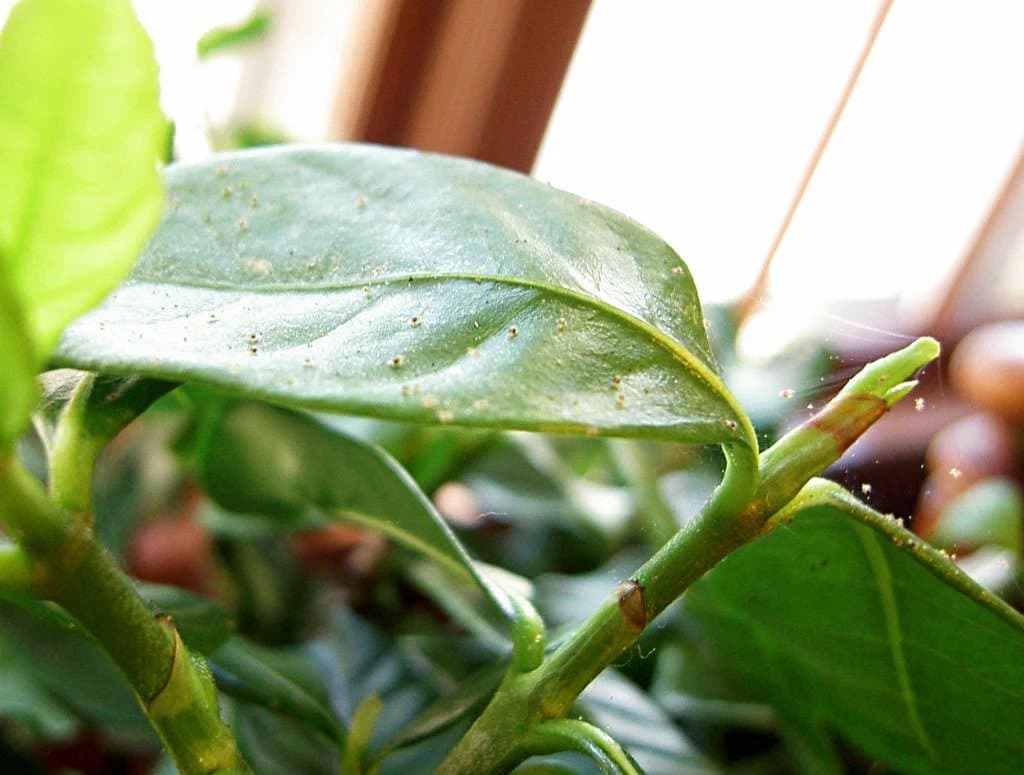
Pale dots on a leaf. A fine web near the stem. Before you reach for a spray, take a closer look.
If you suspect spider mites on a houseplant, move it away from your other plants. Check the leaf undersides with a hand lens. For a sturdy plant, a rinse with plain water can be a useful first step. Keep checking afterward. One rinse does not mean the problem is over. Clemson Extension explains these first steps.
Check that spider mites are there
Spider mites are tiny plant-feeding pests. They are arachnids, related to spiders and ticks, rather than insects. Some other mites eat pests instead of plants, so a moving speck is a reason to look closer, not proof of a problem. University of Maryland Extension explains the differences.
Look at several leaves, especially ones with fine pale dots. Those dots are called stippling. Turn the leaves over. With a hand lens, look for mites, eggs, and fine silk.
You can also hold white paper below a leaf and tap the leaf over it. Look for tiny moving specks, then use the lens for a closer view. The University of Minnesota's mite guide shows what to check. Leaf damage can look like drought stress, so do not diagnose mites from a yellow leaf alone.
| What you notice | What to check | Next step |
|---|---|---|
| Fine pale dots, with or without webs | Leaf undersides and a white-paper tap test | Look for mites before choosing a treatment. |
| Fine webs, but you cannot find mites | Several affected leaves, using a hand lens | Keep checking or ask for help with identification. |
| Mites and fresh feeding damage on several leaves | Other leaves and nearby plants | Follow the indoor or outdoor steps below. |
| Old speckled leaves, with no mites found | More leaves and the plant's growing conditions | Keep notes and recheck. Do not spray only because old damage is still there. |
Sometimes mites have gone by the time you notice the damage. UC IPM recommends checking for them before treatment.
If it is a houseplant, start here
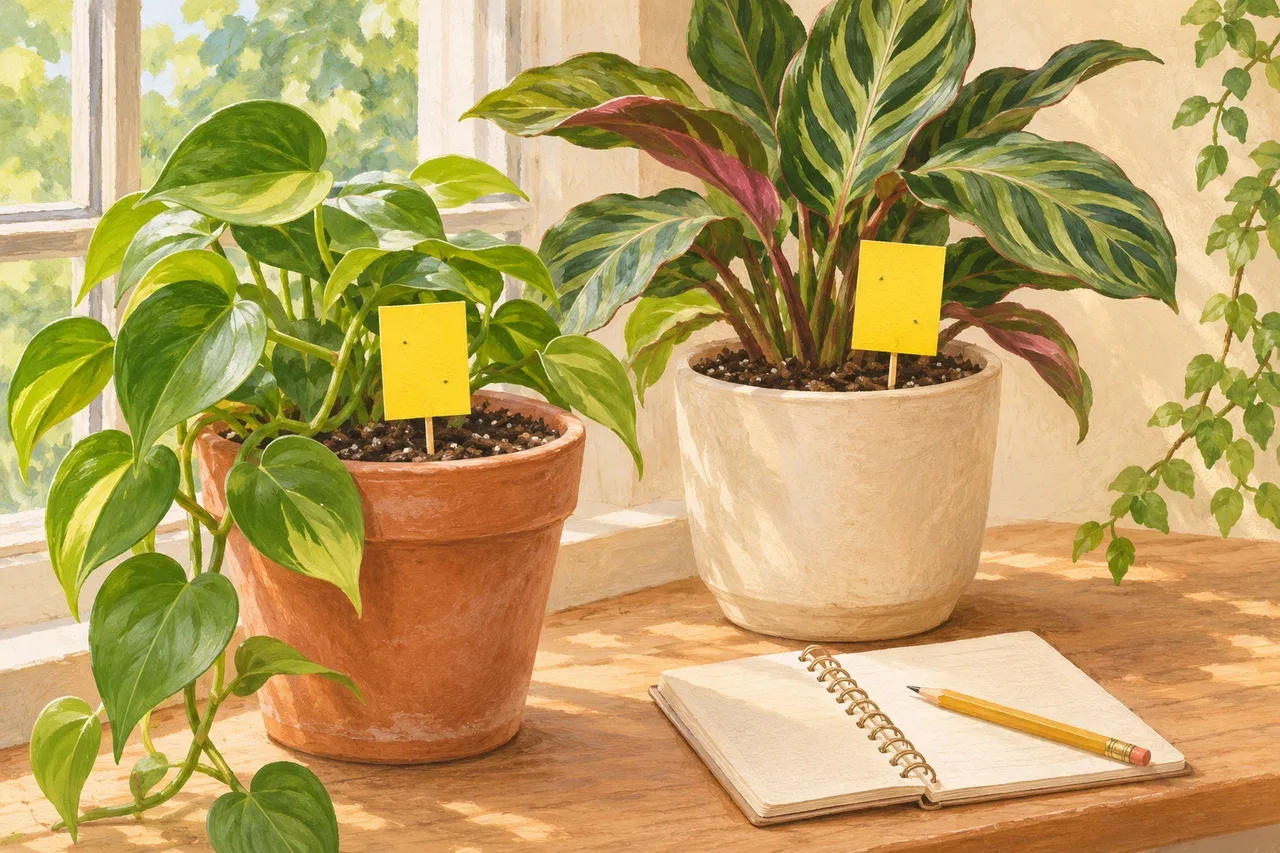
Keep the suspect plant separate while you work out what is wrong. Check the plants that were beside it, too.
For a sturdy plant that can handle washing:
- Take it to a sink or shower where you can reach the leaves.
- Rinse the leaves with plain water, including their undersides. Use enough force to dislodge mites without tearing the plant.
- On smooth leaves, a soft, damp cloth can help remove pests. Support each leaf as you wipe.
- Let the pot drain. Washing the leaves is not a reason to leave the roots sitting in water.
- Keep the plant separate and check it again. Repeat plain-water removal as needed if the plant tolerates it.
The first aim is to remove mites and reduce the damage, not to strip off every marked leaf. Very damaged parts may need pruning. A badly infested, low-value plant may be better discarded than kept beside healthy plants. Iowa State Extension covers rinsing and when to discard a plant.
Keep the care steady
Check the plant's usual water and light needs. Do not keep the pot wet to fight a pest on its leaves. If watering is hard to judge, our watering guide can help you check the pot.
Higher humidity may discourage some mites, but it does not replace finding and removing them. Avoid drought stress, too. Maryland Extension's guidance puts plant care alongside pest control, rather than treating humidity as a cure.
Outdoors, protect the helpers
Outdoor plants have allies. Predatory mites and other small animals eat spider mites. Broad insect sprays can kill those helpers and make a mite problem worse.
First, check whether mites are present and whether damage is spreading. Keep plants from drying out, following their needs. On plants that can take it, a water spray aimed at leaf undersides can reduce mite numbers. Reducing dust also helps protect natural mite predators. UC IPM explains this outdoor approach.
Do not assume every spider mite follows a summer calendar. Twospotted spider mites often cause trouble in hot weather. Spruce spider mites can be more active in cool weather. Maryland Extension explains these differences.
You do not need to buy predators for a typical outdoor bed. Protect the ones already there. Purchased predatory mites need the right pest and conditions; they are not a one-size-fits-all fix for a dry living room. Maryland Extension discusses their limits.
When does a spray make sense?
If confirmed mites keep causing damage after other steps, a suitable pesticide may help. A product sold for insects will not necessarily control mites.
Insecticidal soap and horticultural oil are options in some settings. These sprays need to reach the mites to work. They can also injure some plants, especially under unsuitable conditions. Colorado State Extension explains soap's contact action and limits, and Minnesota Extension covers both soaps and oils.
Read these five parts of the label
Before buying or using a product, check:
- Pest: Does the label cover spider mites?
- Plant: Does it allow use on your plant or crop?
- Place: Is it allowed indoors, outdoors, or in the space you plan to treat?
- Directions: What amount, coverage, and repeat interval does it require?
- Precautions: What does it say about plant sensitivity, heat, protective gear, children, pets, and returning to the area? For food crops, check any waiting time before harvest.
Use the label on the actual container. Do not borrow a rate or schedule from another brand. EPA explains that labels define where, how much, and how often a pesticide may be used.
Follow any small-area test directions before treating the whole plant. Do not spray a sensitive plant simply because the pest appears on the label. Clemson lists plant-injury precautions for soaps and other houseplant treatments.
Skip the homemade mixtures
Do not mix dish soap, alcohol, hot pepper, or essential oils into a homemade mite spray. Household ingredients are not a substitute for a plant-labeled product. “Natural” does not tell you whether a treatment suits your plant or home.
Keep children and pets away as the label directs. Never use an outdoor-only pesticide inside, and never increase the dose to speed things up. EPA's home pest-control guidance covers these precautions.
Recheck before you call it done
Look under leaves every few days while the problem is active. A check is different from a spray: repeat pesticide use only as its label allows.
Keep a short record:
- Date and plant: Which pot or part of the bed did you check?
- Live mites: Found, not found, or unsure?
- Damage: Any new speckling or webbing?
- Action: What did you do, and when is the next check?
This gives you something firmer than “it still looks bad.” Damaged leaves may stay marked. Judge progress by fresh growth and what you find on repeat checks, not by expecting old spots to disappear.
If mites persist, or you cannot tell what is on the leaf, ask your local Extension office. Describe the plant, where it grows, and what you have used. For valuable outdoor plants, a qualified landscape professional may help. Minnesota Extension recommends seeking help when control efforts fail.
Keep the next plant problem smaller
Inspect new plants before bringing them home. Keep new arrivals separate and check them while they settle in. Our nursery plant checklist shows where to look.
Keep care matched to the plant. More fertilizer is not a mite treatment; excess nitrogen can make plants more prone to some pest problems. If you are thinking of feeding a yellow plant, check what it needs first.
A few common questions
Should I change or soak the soil?
Start with the leaves, where spider mites feed. Do not dunk the pot or drench the soil as a general mite remedy. If you find something in the potting mix, get it identified rather than assuming it is the same pest. Use any pesticide only where its label permits.
What kills spider mites instantly?
A contact treatment must reach a mite to affect it. Hidden mites or eggs can remain. There is no single treatment here that promises an instant, lasting fix. Removal, plant care, and follow-up work together.
How do I get rid of the webs?
Plain water can break up webs on a plant that tolerates rinsing. Check the leaf undersides afterward. Removing a web is not proof that every mite is gone.
Will the leaves recover?
Badly damaged leaves will not become whole again, though the plant may grow on after mites are controlled. Its chances depend on the plant and the damage. Maryland Extension notes that heavily damaged foliage may need removal.