You spot a plant you like. It fits your budget, and you can already picture it on your shelf. Before you carry it to the register, take a closer look.
Start with the place it will live. Then check the whole plant, ask a few questions and decide whether you want to bring this one home. You do not need to know every pest or solve every brown spot. You do need a plant you can name, a spot that suits it and a clear idea of any problems you are taking on.
Bring a note about your room
A quick note on your phone gives the nursery staff more to work with than “my room is pretty bright.” Make it before you leave home.
Write down where the plant will sit. Add the window direction if you know it, its distance from the window and whether sun falls on that exact spot. Check at more than one time of day. A photo can help you explain the room, but it is only one moment.
Light changes with distance from a window. Curtains, trees and nearby buildings can also block it. Window direction alone does not tell the whole story. Iowa State Extension explains these indoor light differences.
Try a note like this:
“I have a small table beside the living room window. A building blocks much of the sky. Sun does not fall on the table when I am home in the morning or late afternoon. I can move the table closer to the window.”
That gives you a useful question: “Which plants here could grow well in this spot?” If staff suggest a brighter place or a grow light, decide whether you want to make that change before you buy.
Add three more things to your note:
- Space: Measure the shelf or floor area, including room above and beside it. Ask how wide or tall the plant may grow indoors, and whether it will trail or need support.
- Care: Say how often you are home and whether you travel. Ask what this plant needs you to check, rather than asking for a promise that it is easy.
- Budget: Set a total for the plant, tax and anything you need to use it at home. Check whether the display pot costs extra.
You can admire a plant and leave it at the shop. A good match for your room matters more than filling the empty space today. If you are still choosing a type, our easy houseplants for beginners guide can help you make a shortlist.
Find out exactly what you are buying
Look for a plant name on the tag. “Tropical foliage” does not give you much to look up later. Ask staff for the botanical name—the plant's scientific name—and the variety, if known. Take a photo of the label and the plant. Illinois Extension recommends getting a proper label for an unfamiliar plant.
Ask what its leaves and growth should look like. Compare it with others of the same kind. That is more useful than judging every plant by the same shade of green or the same upright shape.
If you have pets, check the exact name before paying. Use the ASPCA plant database for the animal you have, rather than relying on “pet friendly” on a display. The list is not complete, and even plant material listed as non-toxic can upset a dog's or cat's stomach. If you cannot confirm the plant's identity or its suitability for your pet, pause the purchase and ask your veterinarian.
Look at the whole plant, then the small spaces
First, step back. Look around the plant, rather than only at the side facing the aisle. Check for broken stems, many damaged leaves or a plant that leans so far it is hard to carry or place.
Then move closer. Ask before lifting or turning a heavy pot. Gently raise a leaf if needed; do not pull open new growth or peel parts off to get a better view.
Use this order so you do not keep checking the same leaves:
- Look at the tops of several leaves, including older and newer ones.
- Look underneath those leaves.
- Check where leaves meet stems and around new growth.
- Follow the stems down toward the potting mix.
- Look around the pot rim, outer surface and saucer.
Watch for insects, fine webbing, cotton-like patches, clusters of bumps or a shiny, sticky coating. These are reasons to stop and ask staff to look with you. A phone magnifier may help with small details. University of Minnesota Extension describes these pest signs and the places to check.
Keep your hands off anything that looks like a pest. Let staff inspect it. If pests are found, choose a different plant and inspect that one too.
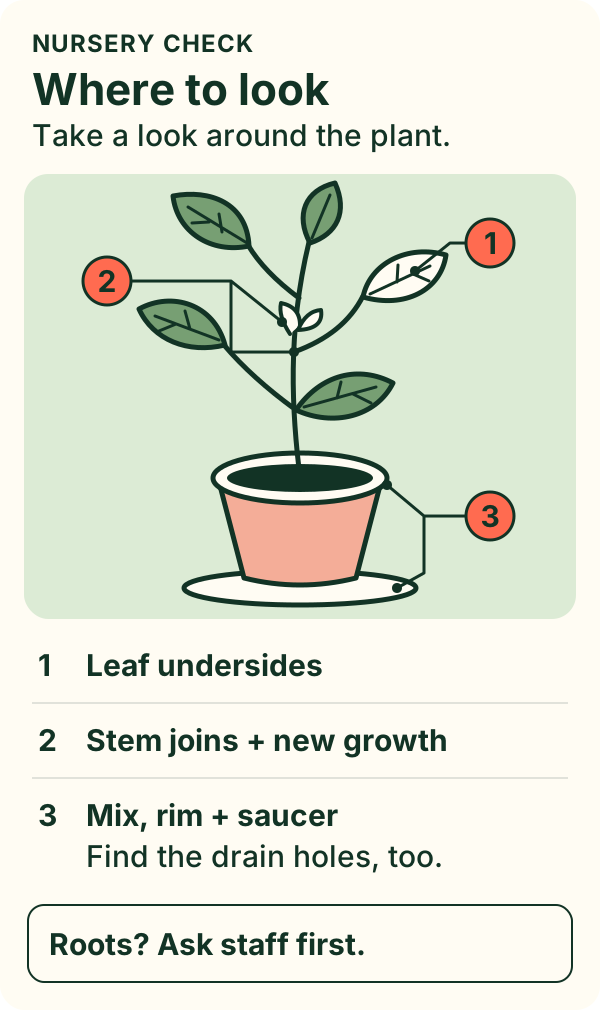
Read diagram as text
- Look at leaf undersides, where leaves meet stems, and at new growth.
- Look around the potting mix, pot rim and saucer. Find the drainage holes too; their position depends on the pot.
- Ask staff before checking roots. This generic drawing does not identify a plant or diagnose a pest.
What about a torn leaf or a brown tip?
A small flaw does not tell you its cause. A few brown edges or small spots can occur on plants in containers; heavy damage is a different concern. Iowa State's plant shopping guide makes that distinction.
Ask about the damage, then look at the rest of the plant. Is it one torn leaf, or are many leaves spotted? Are stems damaged too? Are other plants of the same kind showing the same pattern?
Do not assume that a drooping plant only needs water, or that yellow leaves always mean it has had too much. The same symptom can have several causes. UC's houseplant guidance lists overlapping causes for wilting, yellowing and leaf damage.
For a first purchase, you can choose a plant with fewer questions attached. You do not have to buy a rescue project to learn plant care.
Check the pot and ask about the roots
Look beneath the leaves before choosing a decorative pot. Find out what the plant is actually growing in.
Many displays have a plastic nursery pot tucked inside an outer pot. Lift the inner pot only with permission and check for drainage holes. Ask how to let water drain and how to empty water from the outer pot. Iowa State explains this two-pot setup and why plants should not stand in collected water.
For help comparing container shapes and materials, see our guide to choosing an indoor pot.
Check whether the pot is cracked or hard to lift safely. Look at the surface of the mix and the drainage holes. Roots sticking out can be a clue that the plant has outgrown its pot; ask staff whether it needs a larger one. Illinois Extension includes this in its buying checks.
You do not need to pull a plant out yourself. Ask:
“Could you check the roots with me? Is it safe to slip this one out of its pot?”
Let staff handle it, especially if it is large, fragile or hard to remove. Do not tug on the stems, cut the pot or disturb the roots of stock you have not bought.
If staff can show you the root ball—the roots and mix held together inside the pot—ask them to point out its condition. Ask whether the roots are crowded and whether the plant will need a larger pot soon. Soft or rotting roots are a reason to decline the plant. Do not judge roots by color alone; ask what is normal for this plant. UC recommends checking roots as part of the inspection and avoiding plants with possible disease problems.
If you cannot see the roots, record that as something you have not checked. A leaf inspection cannot tell you everything below the mix. You may prefer another plant if other signs already worry you.
Ask staff these questions before you pay
Show your room note first. Then pick the questions you still need answered:
- “Does this plant suit the spot I described? What would need to change?”
- “What is this mark or damage? Can you help me check the rest of the plant?”
- “When was it last watered, and how should I judge when it needs water at home?”
- “Does it need repotting now? What do you see that tells you that?”
- “Has it recently been repotted, fed or treated for pests? Is there anything I need to know before taking it home?”
- “Is the outer pot included? How do I drain and empty it?”
Write down answers you may forget. You can also ask for care directions tied to the plant's name. A weekly watering day on a tag is not enough detail to settle whether the plant needs water today.
Ask about the store's current return or replacement policy, too. Terms vary. Check the time limit, proof of purchase, any conditions and whether sale plants are covered. Ask how to contact the shop if you spot a problem at home. Keep the receipt and a copy or photo of the written terms.
Choose, ask or walk away
Use this table to make the final decision. “Ask” means pause the purchase until you have a useful answer. It does not mean talk yourself into buying.
| Decision | What you know or see | Your next step |
|---|---|---|
| Choose | You know the plant's name, its needs suit your room, and your inspection has raised no unresolved concerns. You understand the price and pot setup. | Confirm the terms, arrange a safe ride and buy if you want it. |
| Ask | There is one damaged leaf, roots at a drainage hole, an unclear label or a care need you do not understand. | Get help with that point. Compare another plant of the same kind. Decide after the check. |
| Walk away from this plant | You find pests, possible disease, soft or rotting roots, or heavy unexplained damage. The plant will not suit your room or budget. | Choose another plant or leave without one. |
An inspection can help you avoid visible problems. It cannot prove that a plant is free of pests or disease. Keep that limit in mind even when everything looks good.
Three ways this might look in the shop
The pretty plant needs a brighter spot. Your room note shows a shelf far from the window. Staff say the plant needs more light than that spot gets. Your choice is to find a suitable place, plan for added light or pass on this plant. Buying it first leaves the main problem unsolved.
One leaf has a torn edge. You ask staff about it and inspect the leaves, stems and pot. You find no other concern. If you are comfortable with that visible flaw and the plant fits your room, you may decide to buy. The tear alone does not explain the whole plant's condition.
The sale plant has sticky leaves and small bumps. Pause and show staff. If pests are confirmed or the concern remains unclear, leave that plant behind. A discount is only useful if you want—and can manage—what you are buying.
Plan the trip home before checkout
Ask the shop to wrap or sleeve the plant for the weather. Have a place ready in the vehicle so the pot stays upright and leaves are not crushed. Carry the pot, with support underneath if needed, rather than lifting by leaves or stems.
In cold weather, protect the plant on the way to a warmed vehicle. In hot weather, avoid leaving it in a closed car. Keep foliage out of harsh sun through the car window, and make the nursery your last stop. University of Maryland Extension explains how heat, cold and sun can harm plants during transport.
If you are walking or taking transit, tell staff. Check that you can carry the wrapped plant for the whole trip. You may want to choose a smaller one or return when travel is easier.
Make a short handoff at home
Unwrap the plant, save its label and receipt, and take a few clear photos. Note the date, any marks you saw in the shop and what staff told you.
Keep it apart from your existing plants while you watch for missed pests. Give it a spot with suitable light and check the leaves, stems and pot regularly. If pests appear, keep it isolated and identify the problem before choosing a treatment. Clemson Extension recommends keeping additions separate and checking for pests.
Check the mix and use care advice for that plant before watering. Do not add water just to mark its arrival. There is no need to buy a larger pot or fertilizer simply because you bought a plant; ask what it needs and why. Illinois Extension advises checking the soil and avoiding fertilizer while a new plant adjusts.
If you spot a concern, use your photos and receipt to contact the shop promptly under its policy.
Your printable nursery shopping checklist
Copy this section into a note or print it before you go. Fill in the blanks for each plant you are seriously considering.
My room and budget
- [ ] I know the exact spot, its light and the space available.
- [ ] I have described curtains, nearby buildings or other shade.
- [ ] I have told staff about travel, pets and care limits that matter.
- [ ] My total budget, including needed extras: __________
The plant
- [ ] Plant name and variety, if known: __________
- [ ] I checked leaf tops, undersides, stem joints and new growth.
- [ ] I checked stems, the mix surface, pot rim and saucer.
- [ ] I asked about damage, sticky patches, bumps, webbing or insects.
- [ ] I understand the nursery pot, outer pot and drainage setup.
- [ ] Root check: shown by staff / not checked / concern: __________
- [ ] Any unanswered question: __________
Before I pay
- [ ] I know how this plant fits the room I described.
- [ ] I understand any near-term work it needs and the cost.
- [ ] I checked what is included and the return or replacement terms.
- [ ] I have a safe way home and a place apart from other plants.
My decision: Choose / Ask first / Walk away
The reason: __________