A watering can should fit the space around your pots, not just look good beside them. If your current jug reaches the potting mix and is comfortable to use, keep it. A new can is worth considering when it solves a clear problem: an awkward reach, a tight tap space or too many trips for refills.
Start with those checks before choosing a brand. Below, we look at one small indoor can using its maker's published details. We have not tested its pouring, grip or fit in a home.
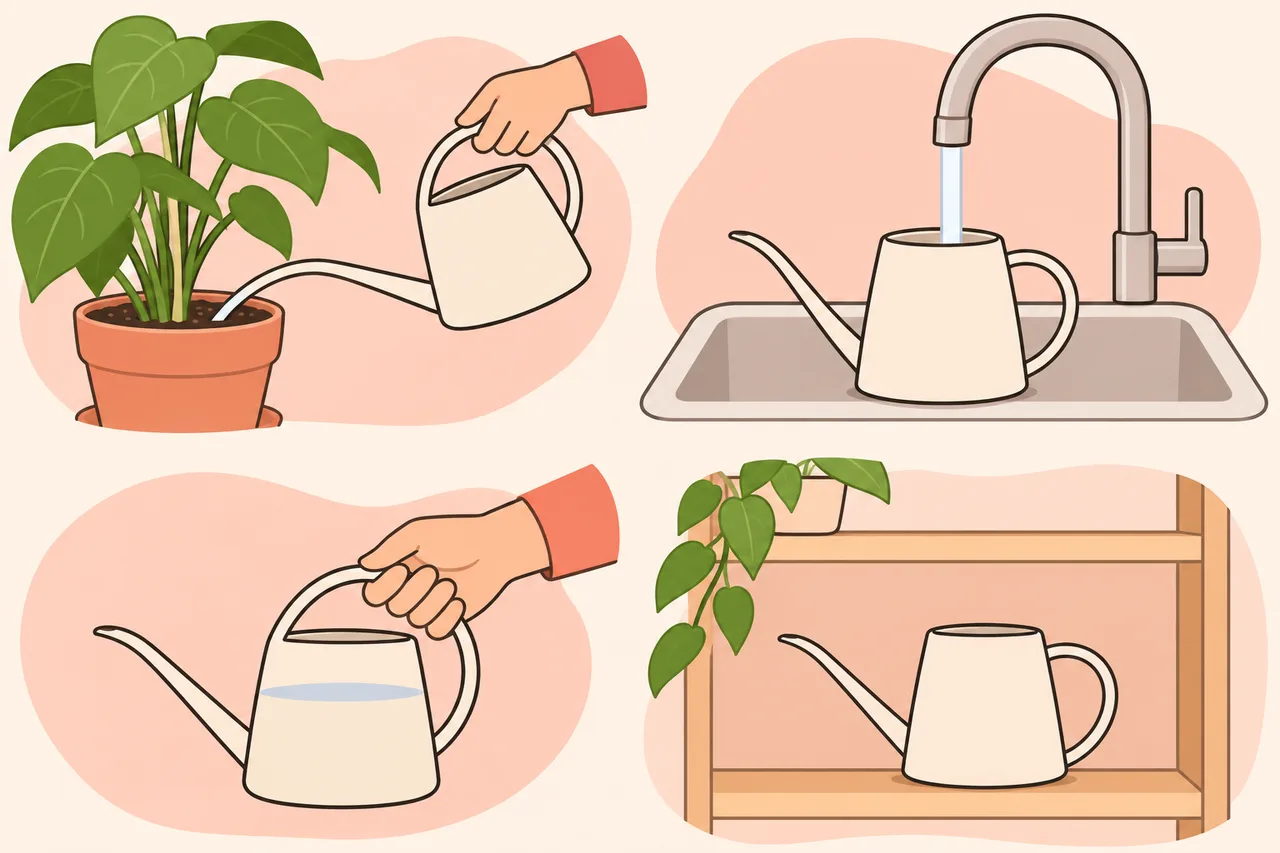
Illustration: leave room to reach the potting mix, fill at your tap, carry comfortably and store the whole can.
What should a watering can help you do?
For an ordinary houseplant in potting mix, the job is simple: get water to the mix when that plant needs it. The spout needs a clear path past the leaves. You need room to tilt the can, then set it down without knocking a pot.
The can's capacity tells you how much it holds, not how much to give each plant. A full can is not a dose. Check each plant's needs and the moisture in its mix before watering; a date on the calendar is a reminder to check.
Choose by the job, then check the fit
Before you compare styles, name the part of watering that is awkward now.
| Your setup | Check before choosing | A useful decision |
|---|---|---|
| Your jug already reaches the mix | Can you pour comfortably and see where the water goes? | Keep it if it does the job. |
| Pots sit behind leaves on a crowded shelf | Look at the gap for the spout and the room needed to tilt the whole can. | Choose a shape that fits that route. A long spout alone does not settle the question. |
| Several pots mean repeated refills | Weigh fewer trips against the amount you are comfortable carrying. | Choose a capacity you can handle; you can also make smaller fills. |
| The tap or storage shelf is low | Measure the filling space and the can's full outside dimensions. | Rule out a can that will not fit before comparing its looks. |
Work through four checks:
- Reach. Find a clear way to the potting mix. Check room for the can's body as well as its spout. If you cannot see or reach the mix, move the pot to a suitable watering spot when it is easy to handle.
- Filling. Measure the space beneath your tap. Compare it with any filling clearance the maker gives. A can may fit in the sink yet be awkward to fill there.
- Carrying and pouring. Think about the water you will carry, not just the empty can. If you can handle a sample in a shop, check the grip and tilt. An empty-can check does not show how a full one will feel.
- Storage. Measure the whole can, including the handle and spout. Check that it can sit on a stable surface where you plan to keep it.
One researched option for small indoor pots
Haws Bartley Burbler, Haws Green
This is a researched option, not a tested winner. Consider it if a small indoor can suits your space and your current jug is awkward to aim at the mix.
For the green plastic model, SKU WEB-100-2-GRN, Haws lists these details:
- Capacity label: “Two Pint (1 L)”. This is the maker's nominal label, not an exact unit conversion.
- Dimensions: 27 cm long × 11 cm wide × 22 cm tall.
- Filling clearance: 14 cm beneath the tap.
- Included attachment: a removable Bartley Burbler Plastic Rose. A rose is the perforated head that turns the flow into a spray.
Haws describes a direct stream with that rose removed and a spray for seeds and seedlings with it attached. For this model, use only its supplied rose; do not assume another Haws attachment will fit. The rose is not needed for ordinary pot watering.
The published dimensions give you something concrete to compare with your tap and storage space. They do not tell you whether the grip will suit your hand or how the can will pour around your plants. We have not measured the can or checked it for spills.
Consider it if you want a small, separate indoor pouring tool and its dimensions fit your space. Skip it if your current jug works, the tap clearance is too low, you would find the refills tiresome, or the grip and pour feel awkward. Choosing a small can does not mean filling it to the top each time.
If you buy through this link, Plants Spark Joy may earn a commission. As an Amazon Associate I earn from qualifying purchases.
Make the choice, then plan for drainage
Choose the tool that solves your actual problem. Keep a jug that works. If you need a change, use your reach, filling, carrying and storage checks to narrow the choice. You do not need separate indoor and outdoor cans just to complete a set.
Before you water, also decide where the excess water will go. With an ordinary pot that has drainage holes, a sink can be useful when the pot is easy to move. Let excess water drain and empty the ordinary saucer or cover pot before returning the plant. Use your existing suitable saucer; a new can does not call for a new one.
For a heavy pot that stays in place, arrange a safe way to collect and remove runoff first. If you cannot do that, do not water it in place until you can. A container with a designed reservoir needs its own instructions, rather than the ordinary-saucer rule.
Use our watering guide to check the plant's needs and plan the watering step. Then choose a can only if it makes that job easier for you.