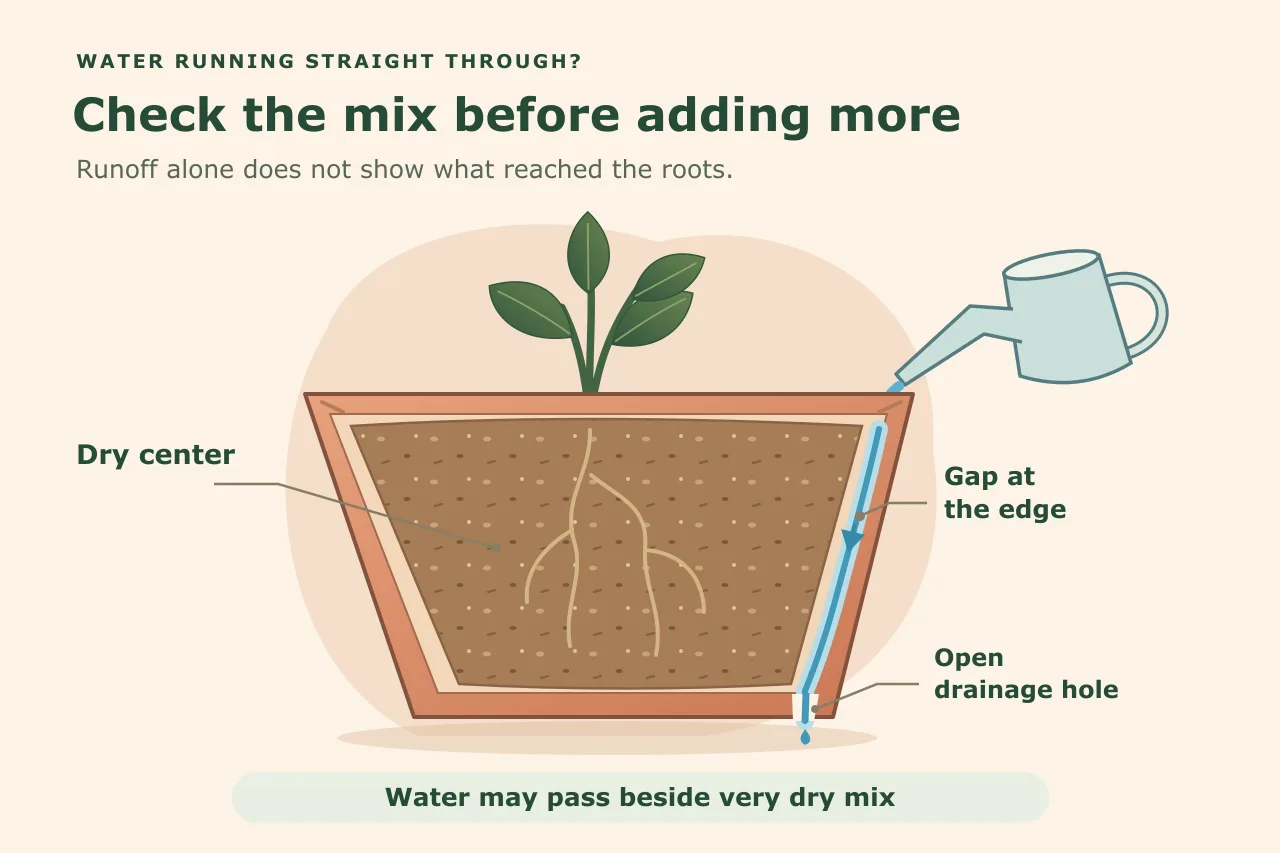
You water a plant, the saucer fills, and the mix still feels dry. Did the water reach the roots?
Check the mix before pouring more. Very dry potting mix can be hard to wet, letting water run around it and out of the pot. Crowded roots can also make water run straight through. Runoff alone does not tell you which is happening. University of Minnesota Extension describes these two possible causes.
Check what the water and mix are doing
Start with the plant's usual moisture check. Feel the mix where you normally check it, using care guidance for that plant. If you know how heavy this same pot feels after watering, its weight can be another clue. Only lift a pot you can handle safely.
Look for a gap between the mix and the pot wall. Mix that has dried and pulled away from the sides may need several applications of water to take up moisture again. University of Maryland Extension explains this dry-mix problem and the weight check.
A pale surface or a drooping leaf is not enough to settle the question. A plant with wet mix can wilt too, so check before treating it as thirsty.
Choose the next step from what you find
Runoff is one clue. Use these checks to choose a next step rather than a diagnosis from the saucer alone.
Water drains and the mix has taken up moisture
Check the mix and, if useful, compare the pot with its familiar watered weight. If water has soaked in, runoff may simply be normal drainage. Let the pot drain and empty its saucer or ordinary cover pot. You do not need to keep adding water because some has come out.
Water slips down the sides while the mix stays dry
Look for that gap around the pot's edge. If the mix is still dry, water may be passing it rather than soaking in. Try the careful rewetting steps below before assuming the plant needs a bigger pot.
Quick runoff keeps returning and the pot dries unusually fast
Check whether roots have filled the growing space. Crowded roots are one possible cause, but a root at a drainage hole is only a clue. Use our indoor-pot guide to assess root space and the next pot size. Illinois Extension lists signs that can prompt a repotting check.
The plant droops but the mix is already wet
Do not use a dry-mix rescue. Check drainage and what water has been added recently. Excess moisture can reduce oxygen around roots and cause wilt that resembles drought stress. It does not prove a particular disease. Read University of Maryland Extension's explanation of overwatered plants.
Rewet dry potting mix in a pot that drains
These steps are for an ordinary potting-mix plant in a growing pot with drainage holes. Remove a decorative outer cover first. Work over a sink, tub or other suitable place where runoff will not damage a surface. Get help with a pot that is too heavy to move safely.
Try several slow applications first
Apply water across the mix rather than sending the whole pour down one side. Give it a chance to soak in, then apply more as needed. Check whether the mix is taking up water instead of judging only by what leaves the drainage hole.
Iowa State Extension recommends several applications when very dry mix lets water run around the root ball. See its guidance on rewetting houseplant mix.
Use bottom watering only if the dry mix still needs help
For a manageable pot, setting its base in a container of water can let the mix take up moisture through the drainage holes. Check it while it takes up water. Once the mix has taken up moisture, lift the pot out and let it drain. Do not leave the pot soaking unattended or turn this rescue into a standing-water setup.
University of Maryland Extension describes bottom watering and removing excess water afterward. There is no single soak time to use for every plant, pot and mix. University of New Hampshire Extension also treats soaking as an occasional response to mix that has dried completely, rather than a routine task.
Let the pot drain, then check it again
Empty water that collects in an ordinary saucer or cover pot. Keep the growing pot out of that runoff. A designed reservoir system has its own instructions and should not be managed as an ordinary saucer. Illinois Extension explains draining and emptying double pots.
For the next watering, return to the plant's established moisture cue. Do not add another drink just because a damaged leaf has not changed. If the mix is wet and the plant keeps declining, investigate the conditions or ask for local plant-care help.
If it keeps happening, inspect the pot and roots
Repeated quick runoff deserves a closer look. Check for crowded roots and mix that no longer works well. Potting mix can break down and become compacted over time; that may call for repotting with a suitable fresh mix. Iowa State Extension covers these repotting signs.
Record what you found after watering and at the next moisture check. That gives you something more useful than simply pouring more each time. Our general watering guide covers the wider care routine.
Use separate care directions for orchids in coarse bark, water-grown plants and designed reservoir systems. Cacti, succulents and other specialist plants also need moisture checks suited to them. This guide is not a reason to keep every plant's mix moist.
You may be able to solve the problem with your current supplies. If your jug makes a slow, directed pour difficult, our watering-can guide can help you check reach, handling and fit before buying. A new can is optional; checking the mix and giving water a chance to soak in come first.