A root curls out of a drainage hole. Does your plant need a bigger pot already?
Check the whole root ball before deciding. Roots beneath the pot are a reason to look more closely. They do not show you how much room is left inside. Loose roots with mix between them call for a different next step than a thick mat circling the outside. Wisconsin Extension explains this root-ball check.
If roots are caught in a hole, stop pulling. Pause the inspection instead of tearing them free.
Look beneath the pot, then check the plant
Find the pot that actually holds the roots and mix. It may be a plastic growing pot inside a decorative cover. Lift the inner pot out only if you can do so safely and easily. Empty any collected runoff; an ordinary cover pot should not keep the growing pot standing in water. Iowa State Extension describes this two-pot setup.
Look at the roots underneath. Are there a few tips, several long roots, or a mat spread across the base? Are they caught around a hole? Note what you see, but do not use root length or count as a rule for pot size.
Think about recent changes too:
- Does the mix dry much faster than it used to in the same spot?
- Does the plant wilt between its usual moisture checks?
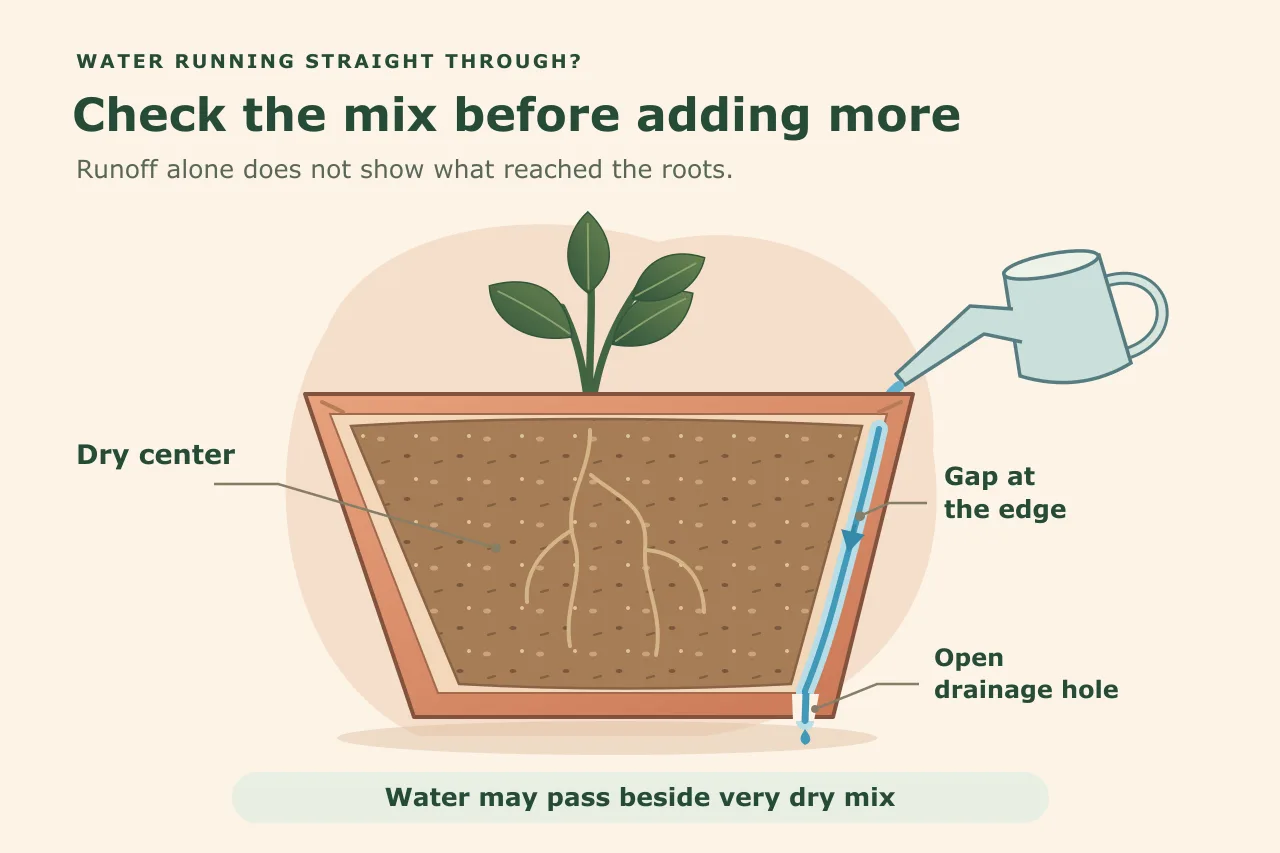
- Has water started running straight through while the mix stays dry?
Fast drying can accompany crowding, but it does not settle the question. Very dry mix can also let water run past it. Use our runoff and dry-mix guide if that is what you notice.
The inspection below is for a small, manageable houseplant in ordinary potting mix. Get help with a heavy, spiny or fragile plant. Orchids in coarse bark, water-grown plants and designed reservoir systems need guidance for that plant and setup.
Slip the pot off only if it releases easily
The root ball is the roots and mix held together inside the container. You are checking its outside, not washing away all the mix or taking the roots apart.
Work over a tray or covered surface. Make room to set the plant down with its root ball supported. For a manageable plant:
- Support the mix and root ball with your hand, keeping stems between your fingers rather than gripping them.
- Tip the pot while supporting the plant, then gently move the container away from the root ball. Do not pull the plant out by its stems.
- If a flexible plastic pot is holding the mix, gently squeeze its sides to loosen it. Do not squeeze a rigid or brittle pot.
- Stop if the pot does not release easily or if outside roots catch at a hole.
PlantTalk Colorado describes supporting the mix while removing the container. Iowa State also suggests squeezing a plastic pot to loosen the root ball.
If roots are caught in a drainage hole
Set the plant down with the root ball supported. Avoid pulling harder or clipping every root you can see just to get the pot off.
A plant that has grown into a plastic pot may need the pot cut away. Montana State Extension notes this option for a stuck plant. Ask someone experienced to help if cutting is needed. Keeping the pot intact is less useful than avoiding damage to the plant or your hands.
For a rigid ceramic or glass container, get help choosing a removal method. Do not try to free the plant by smashing the pot around its roots.
Use the whole root ball to choose a next step
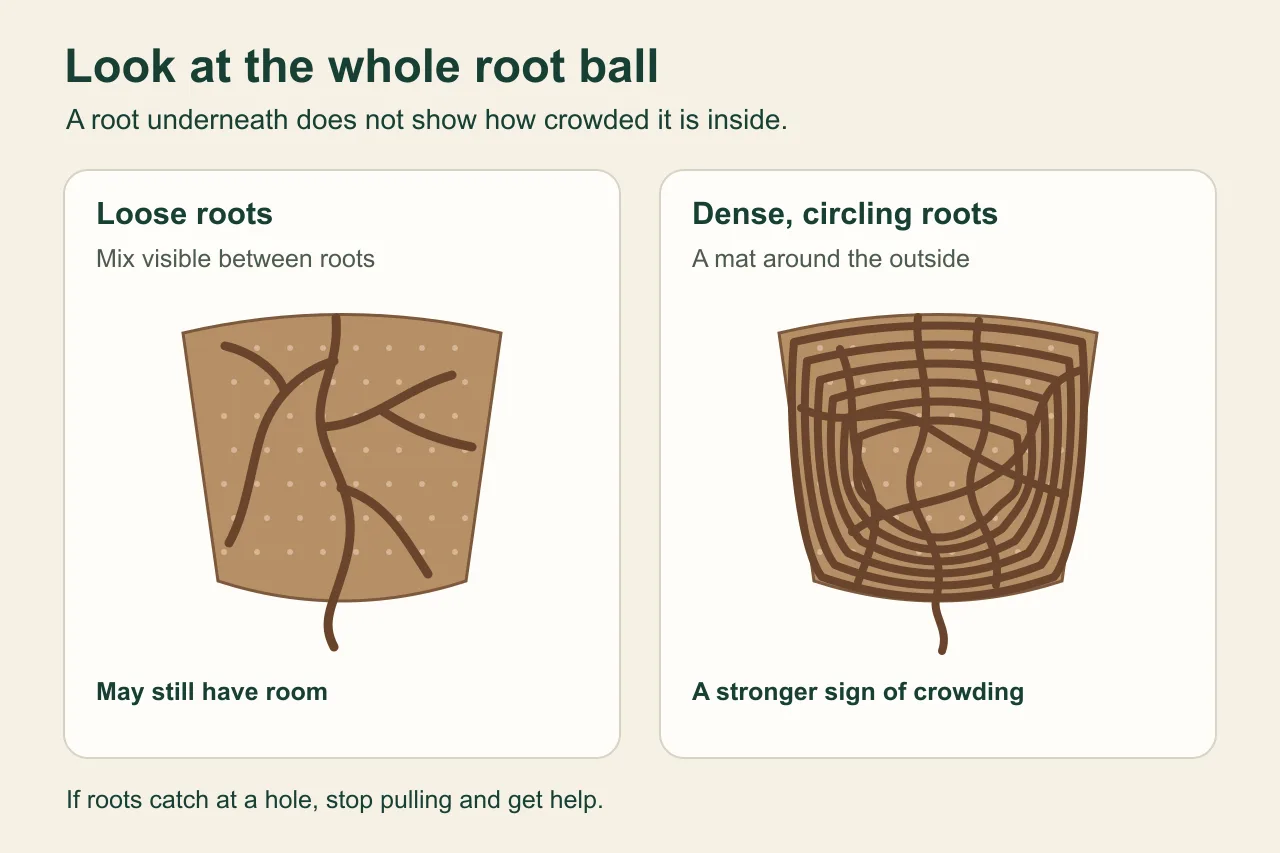
Once the pot comes away, look around the sides and bottom. Do not judge crowding from the longest root alone. The illustration compares the overall pattern to look for.
Loose roots with mix between them: keep the current pot
If roots are loose and mix falls away easily, the plant may still have room. Wisconsin Extension advises returning this kind of root ball to its container and gently firming the mix.
Set it back at its previous depth. Resume moisture checks suited to the plant. An escaped root does not mean you must buy a bigger container or start trimming healthy roots.
A dense mat circling the outside: plan to repot
Abundant roots circling the outside, with little loose mix, are a stronger sign that the plant has filled its container. Check the needs of the named plant before loosening or pruning that mat; root handling is not the same for every houseplant.
If more root space is needed, use our indoor-pot guide to choose a suitable next container. It covers drainage, a modest size increase, stability and cover-pot fit. A much larger pot is not a shortcut: extra mix can stay wet longer than the roots need.
Soft or rotting roots: assess root health first
Crowding is not the only possible problem below the mix. Soft or rotting roots, especially with a plant declining in wet mix, call for a closer assessment. PlantTalk Colorado distinguishes firm roots from mushy ones. Moving the plant into a larger pot does not identify or fix the cause by itself.
Do not use root color alone to decide which roots to cut. If you are unsure what is normal for the plant, ask a local extension service or an experienced grower for help. Share its name, photos and recent watering conditions.
Does it need to happen today?
For routine repotting, the start of active growth is usually a good time. For many houseplants grown with seasonal window light, that means spring. Wisconsin Extension recommends this timing, while Iowa State notes that repotting can be done at other times.
A healthy plant with loose roots does not need a move just because the calendar says spring. A declining plant needs its conditions assessed now, rather than waiting for a date. Let the root-ball check, the plant's condition and its specific care needs guide the next step.
Make one useful note before you put it back
Record the date and a short finding: “roots through one hole; loose mix between roots; returned to same pot,” or “dense circling mat; arranging help to repot.” Add any recent change in drying or watering.
That note gives you something to compare at later care checks. For now, choose the action your inspection supports: keep the pot, plan a repot, or get help with a stuck or unhealthy root ball.